
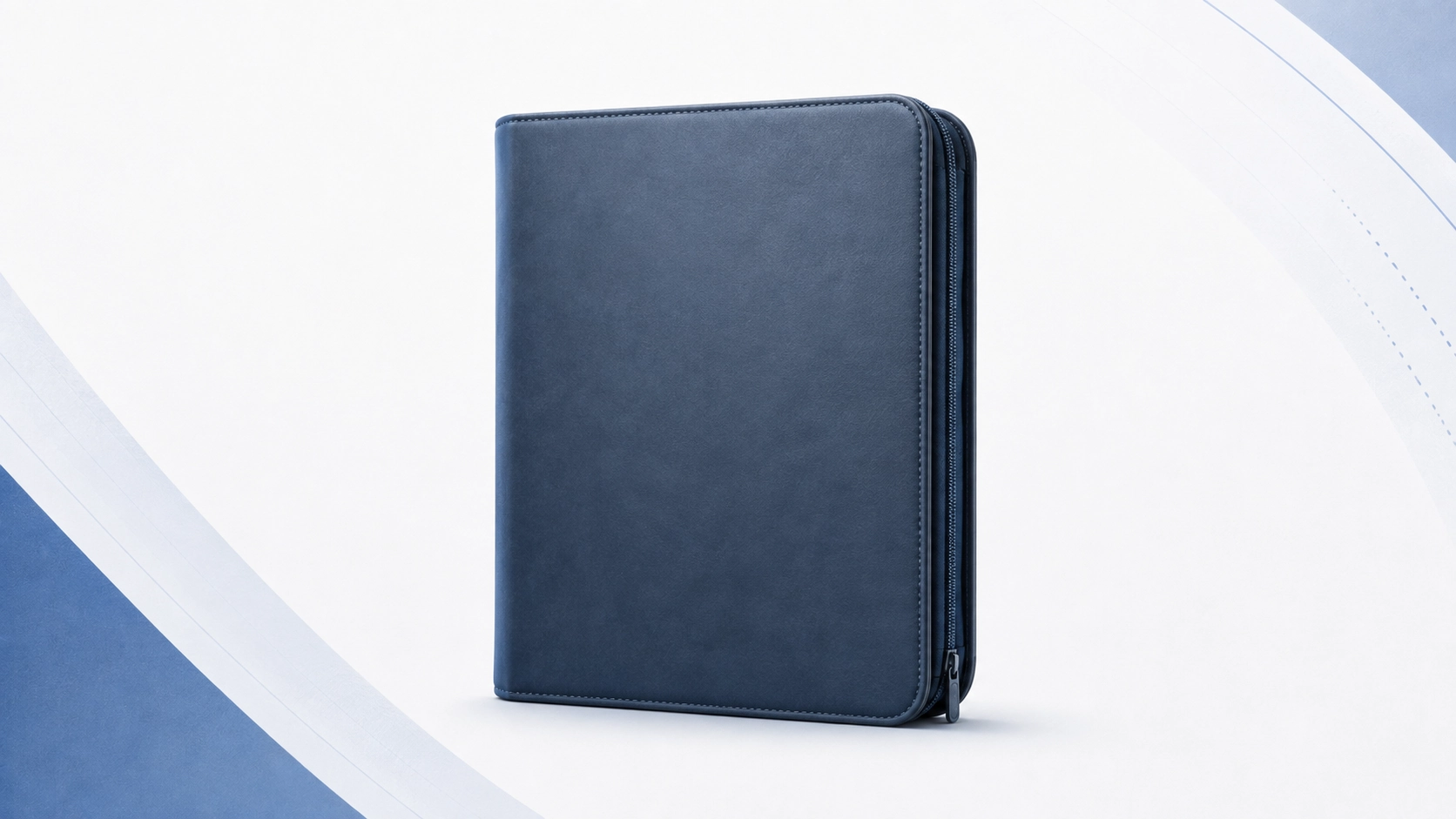
A good trading card binder does not need to be complicated. It needs pockets that hold your cards securely, pages that feel well made and enough space for the collection you actually want to store.
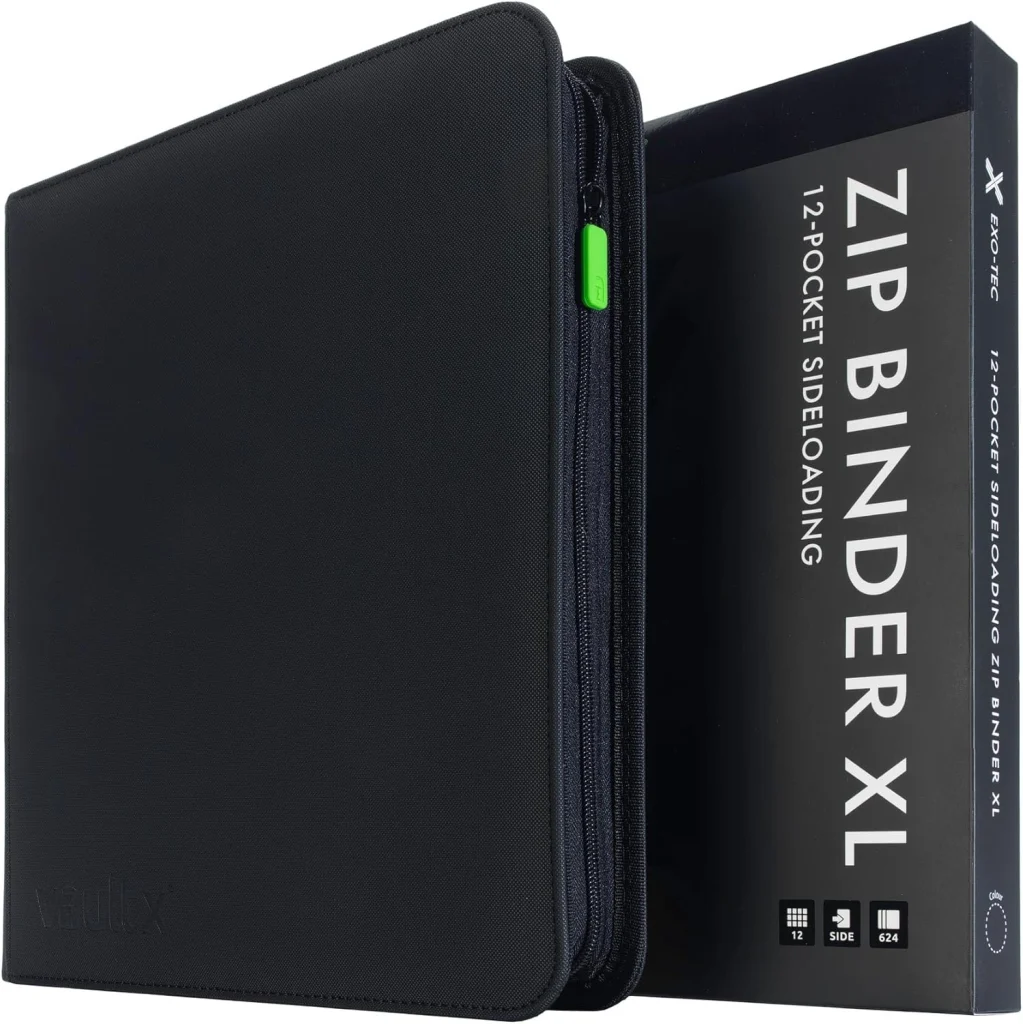
Vault X is the binder brand we use for our own card collections, and it is the brand we would choose first. For a large collection, our favourite is the Vault X 12-Pocket Exo-Tec Zip Binder XL. It holds up to 624 cards, has fixed side-loading pages and closes completely with a zip.
It is a big binder, though. If you are storing a smaller set, favourite cards or a trade collection, the compact 160-card Vault X can make much more sense.
| Binder | Capacity | Layout | Closure |
|---|---|---|---|
| Vault X 12-Pocket XL | 624 | 12-pocket | Zip |
| Vault X 4-Pocket | 160 | 4-pocket | Zip |
| Vault X 12-Pocket Strap | 480 | 12-pocket | Strap |
| TiopLior 9-Pocket | 432 | 9-pocket | Zip |
| khlerox 440-Pocket | 440 | 4-pocket | Zip |
The best trading card binders
Vault X 12-Pocket Exo-Tec Zip Binder XL
The link below is an Amazon affiliate link.
Capacity: 624 cards
Layout: 12 pockets per side
Pages: 26 double-sided fixed pages
Pocket size: 68 × 97 mm
Closure: Zip
This is the Vault X binder we would choose for a large collection. It has 26 fixed page leaves, with 12 cards visible on each side, giving you 624 card spaces altogether.
The pockets load from the side and measure 68 × 97 mm. Vault X says they will take standard gaming cards as well as single- and double-sleeved cards, which gives you plenty of flexibility if you prefer to sleeve cards before putting them into a binder.
The Exo-Tec cover is padded and water-resistant, and the zip closes around the outside of the pages. We like zipped binders for larger collections because once the binder is closed, the page block is completely enclosed rather than simply being held shut by a strap.
The main thing to consider is its size. At roughly 350 × 340 mm, this is a genuinely big binder, and once hundreds of sleeved cards are inside it becomes fairly bulky. If you only have 100 or 200 cards to organise, buying the XL simply means carrying around a lot of empty pages.
For a substantial Pokémon collection, a large set project or any collection that you want to keep together in one binder, though, the capacity is a real advantage. We use Vault X binders for our own cards and would be comfortable putting cards we care about into this one.
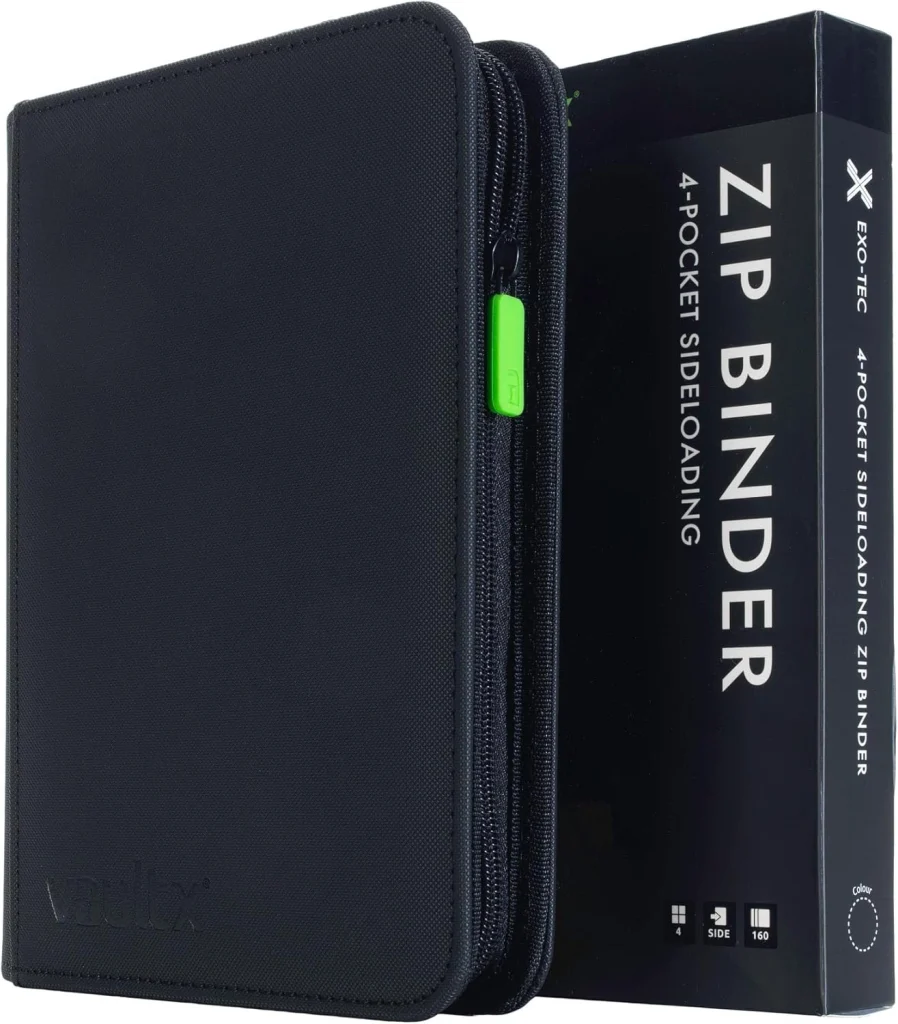
Vault X 4-Pocket Exo-Tec Zip Binder
The link below is an Amazon affiliate link.
Capacity: 160 cards
Layout: 4 pockets per side
Pages: 20 double-sided fixed pages
Pocket size: 68 × 97 mm
Closure: Zip
The 4-Pocket Exo-Tec is basically the compact version of the larger Vault X zip binders. It has 20 fixed page leaves with four pockets on each side, giving you space for 160 cards.
The pockets are the same 68 × 97 mm size and load from the side, so you are not giving up the basic card-storage design by choosing the smaller binder. Vault X also says these pockets accept single- and double-sleeved cards.
Where this binder really makes sense is portability. At roughly 245 × 190 mm, it is much easier to carry around than the 624-card XL. We could see it working particularly well for favourite cards, trades, a smaller set or any collection you want to take with you regularly.
Of course, 160 spaces can disappear quickly if you start collecting complete modern sets. If you already know you have several hundred cards to organise, buying one of these will probably just lead to buying another binder later.
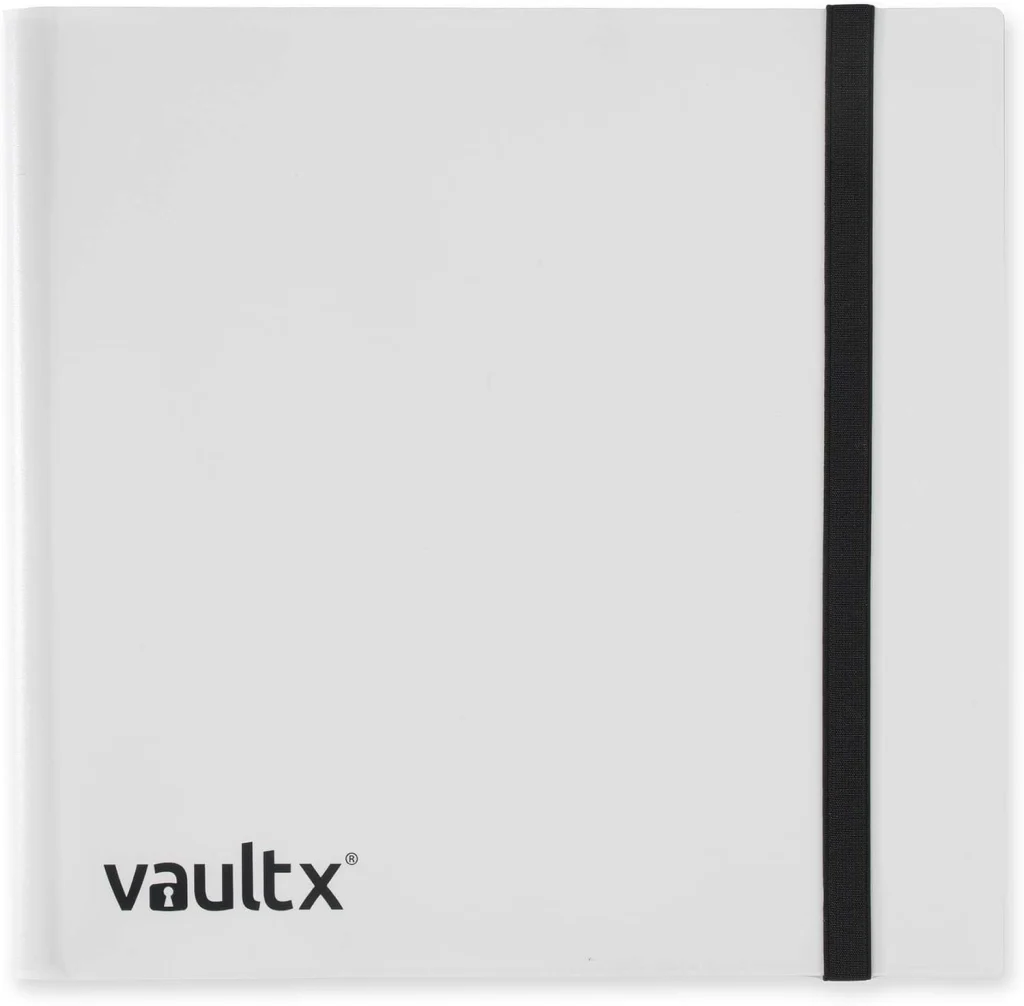
Vault X 12-Pocket Strap Binder
The link below is an Amazon affiliate link.
Capacity: 480 cards
Layout: 12 pockets per side
Pages: 20 double-sided fixed pages
Pocket size: 68 × 97 mm
Closure: Elastic strap
The Vault X 12-Pocket Strap Binder gives you the same large 12-pocket page layout without the zip. Its 20 double-sided page leaves hold 480 cards, so it still has enough room for a sizeable collection.
The pages use the same 68 × 97 mm side-loading pockets as the other Vault X models here, and Vault X says they accommodate single- and double-sleeved cards. The main difference really is the way the binder closes.
An elastic strap keeps the covers together but leaves the outside edges of the pages exposed. A zip goes all the way around them. We would therefore lean towards a zipped binder if it is regularly going into a backpack or travelling to events.
For a collection that mostly stays at home, however, there is nothing inherently wrong with the strap design. It is simple, easy to open and avoids some of the extra bulk of a zipped cover.
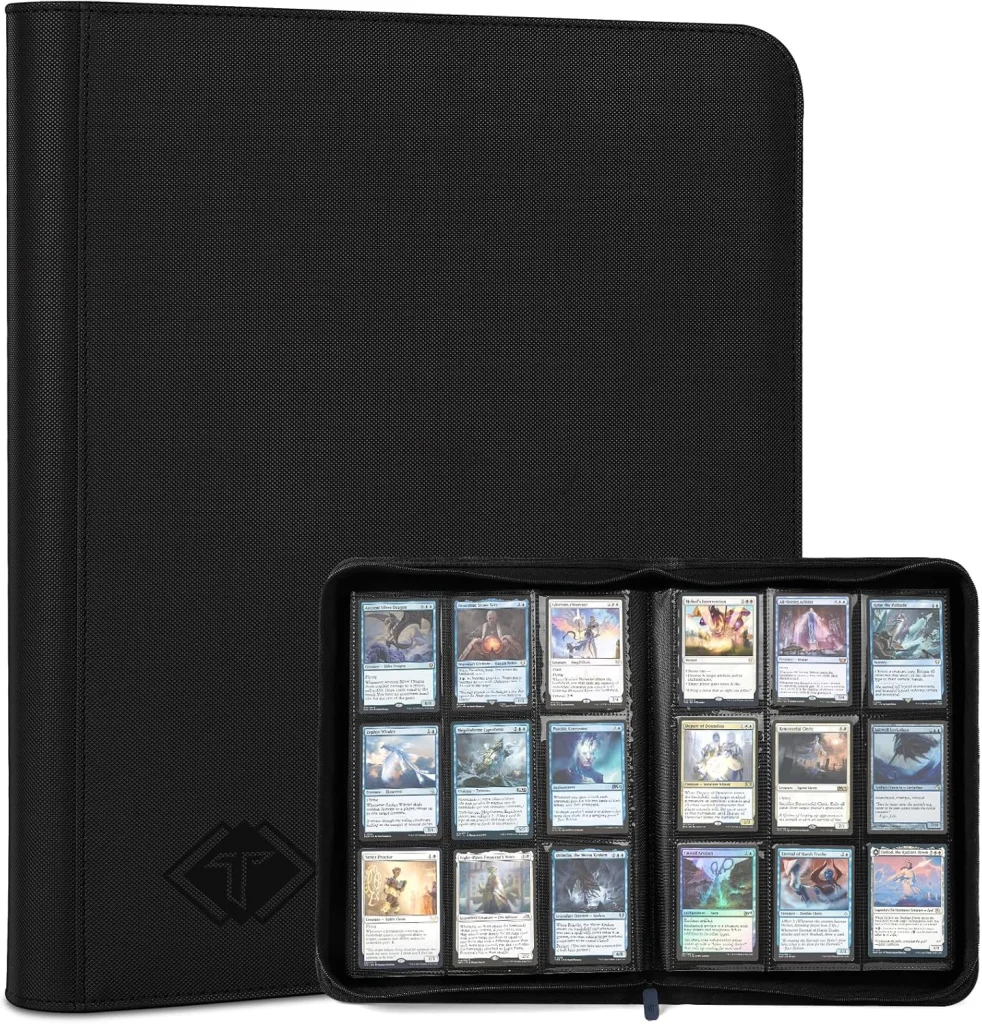
TiopLior 9-Pocket Zip Trading Card Binder
The link below is an Amazon affiliate link.
Capacity: 432 cards
Layout: 9 pockets per side
Pages: 24 double-sided pages
Closure: Zip
Loading: Side-loading
The TiopLior holds 432 cards across 24 double-sided pages. Each side has the familiar nine-pocket, three-by-three layout, so it feels more like a traditional card album than the wider 12-pocket Vault X binders.
It has side-loading pockets and a full zip, which are both features we like to see on a binder. The 432-card capacity also gives you plenty of room without making the binder quite as wide as a 12-pocket model.
The main reason we still prefer Vault X is simply that there is more information available about exactly what you are buying. With the TiopLior, the pocket dimensions and compatibility with thicker or double-sleeved cards are not as clearly documented.
That does not make it a bad binder. If you prefer a traditional nine-pocket layout and want a zipped, side-loading album with plenty of capacity, it is a sensible alternative. We would just be a little more cautious if we were filling it with particularly valuable cards or thick sleeve combinations.
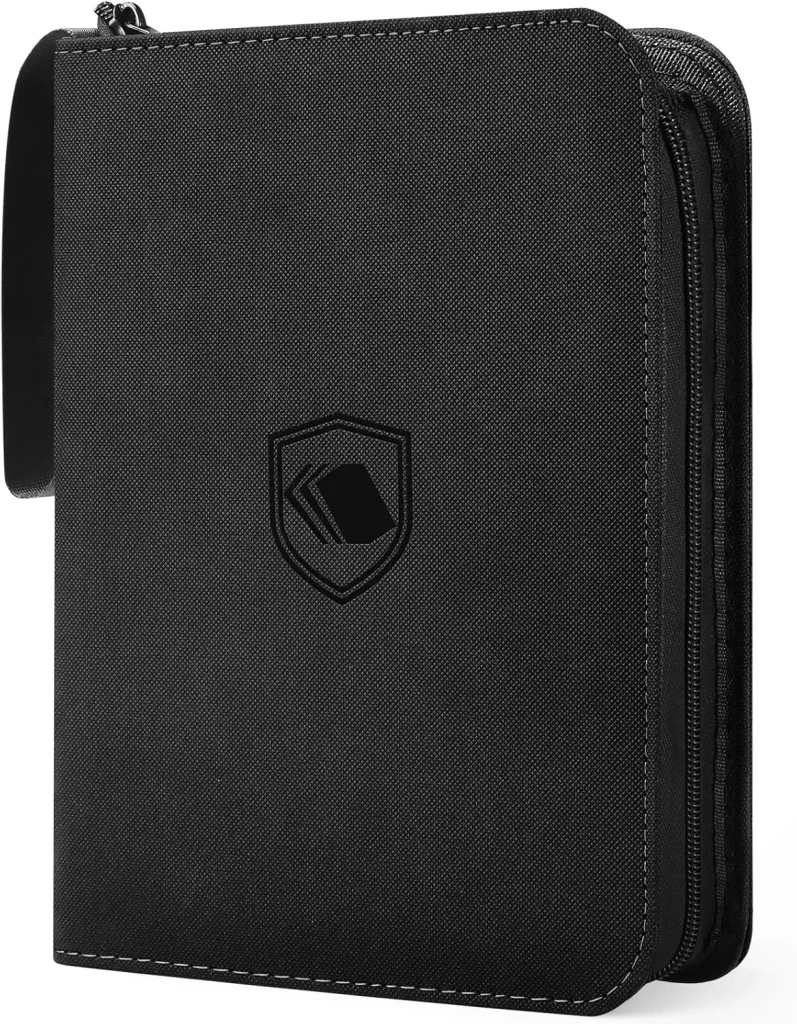
khlerox 440-Pocket PU Zip Trading Card Binder
The link below is an Amazon affiliate link.
Capacity: 440 cards
Layout: 4-pocket
Cover: PU
Closure: Zip
The khlerox binder holds up to 440 cards and uses a zipped PU cover. On paper, that gives you a lot of card storage in one binder, particularly if you want to keep a collection together instead of spreading it across several smaller albums.
There is less information available about the pockets themselves than there is with the Vault X binders. We could not verify the exact internal pocket dimensions or get the same clear confirmation about the materials used for the card pockets.
That would not necessarily stop us using it for ordinary cards, but we would be more cautious with a valuable collection. If cards are going to sit in the same binder for years, we prefer knowing the pocket size, what sleeves will fit comfortably and what material is actually surrounding the cards.
The 440-card capacity and zip are appealing, but this is one of those cases where we would choose the better-documented Vault X binder for cards we particularly care about.
What should you look for in a trading card binder?
The first thing to think about is how many cards you actually want to store. A huge binder sounds useful until you realise you are carrying hundreds of empty pockets, while a small binder becomes annoying if you need to split one collection across several albums.
After capacity, we would look at the pockets, page style and closure. Those are the parts of the binder that affect how the cards sit inside it and how convenient it is to use.
Side-loading pockets
Most of the binders we prefer use side-loading pockets. Instead of dropping the card in through the top, you slide it into the pocket from the side, with the opening facing towards the middle of the binder.
That helps keep cards from working their way out of the top when the binder is picked up or turned. It is not magic, and a badly fitting pocket can still allow movement, but for a modern fixed-page card binder we would generally choose side loading.
Fixed pages or a ring binder?
Fixed-page binders are simple because the pages are permanently attached and there are no metal rings inside the binder. That removes the possibility of a card or loaded page being pressed against a ring when the binder is closed.
That does not mean every ring binder damages cards. A good D-ring binder can be used carefully, and being able to add, remove or rearrange pages is genuinely useful.
For straightforward collection storage, though, we prefer fixed pages. There is less to think about, and you cannot accidentally overfill the binder with extra page sheets.
Zip or elastic strap?
A zip closes around the outside edges of the pages, while an elastic strap simply holds the front and back covers together.
We prefer a zip when a binder is going to be carried around because the pages are more enclosed once it is shut. For a binder that mainly lives on a shelf, a strap is perfectly reasonable and makes opening the binder slightly quicker.
We would still pay more attention to the quality of the pages and pockets than the closure. A zip is useful, but it cannot turn a poorly made binder into a good one.
Pocket materials
For cards that may stay in a binder for a long time, we like to see clear information about the materials used in the pockets. Terms such as archival-safe, acid-free and PVC-free are useful because they tell you more than simply calling a binder “protective”.
They are not a guarantee that a card can be forgotten about forever. Heat, humidity, sunlight and handling still matter, but we would rather buy a binder that tells us what its card-contact materials are made from.
Sleeved and double-sleeved cards
A standard trading card is roughly 63 × 88 mm, while the Vault X pockets in this article measure 68 × 97 mm. That extra room allows the pocket to take the card with a sleeve around it rather than forcing a bare card into a very tight space.
Not every binder will take every sleeve combination, though. A penny sleeve adds relatively little bulk, while an inner sleeve plus a thicker deck sleeve can make the card noticeably wider and thicker.
Vault X specifically says the three models above accept single- and double-sleeved cards. If another binder does not give you that information, we would not assume a thick double-sleeved card will fit comfortably.
The sleeve itself therefore matters as well as the bare card size. Different trading card sleeves can add different amounts of material around the card.
Capacity and page layout
A 4-pocket, 9-pocket or 12-pocket binder is describing how many cards you see on one side of a page. It is not the total number of cards in the binder.
For example, a 4-pocket page has four card positions on the front and another four on the back. A double-sided page therefore holds eight cards altogether.
The same calculation explains the larger Vault X models. The 480-card binder has 20 page leaves with 12 pockets on each side:
20 × 12 × 2 = 480 cards.
The XL increases that to 26 leaves:
26 × 12 × 2 = 624 cards.
This is worth checking when comparing binders because marketplace titles are not always very clear about the difference between pockets on one side of a page and the total binder capacity.
Which binder should you use for different trading card games?
For most trading card games, you do not need a game-specific binder. If the card and its sleeve fit the pocket properly, the same good-quality binder can be used for Pokémon, Magic: The Gathering, One Piece, Lorcana and Yu-Gi-Oh!.
The bigger differences are usually how many cards you collect and how you want them arranged on the page.
Best binder for Pokémon cards
Pokémon cards are approximately 63 × 88 mm, so they fit the standard trading card pockets used by the Vault X binders in this article. Vault X also states that its 68 × 97 mm pockets work with sleeved standard gaming cards.
For Pokémon, capacity is probably the biggest decision. A 160-card binder is plenty if you are keeping favourite cards or a smaller collection, but it can fill very quickly if you start completing full sets.
The 624-card Vault X XL makes much more sense for a large Pokémon collection or a master-set project. Its 12-pocket pages show four cards across, which also gives a different look from the traditional three-by-three layout of a 9-pocket binder.
We would normally sleeve Pokémon cards before putting them into a binder, particularly anything we care about keeping in good condition. The sleeve stays with the individual card when it is taken out of the binder and gives it another layer of protection during handling.
Best binder for Magic: The Gathering cards
Magic: The Gathering cards use the same standard card format, so there is no need to buy a completely different type of binder for MTG.
A smaller binder can work well for trades or selected valuable cards, while a larger 9- or 12-pocket binder is easier to organise if you have a much bigger collection.
One nice feature of a 12-pocket page for MTG is that its four-card rows can work well when you deliberately keep playsets together. That is an organisational benefit rather than a protection difference, but it can make the binder easier to use.
Best binder for Yu-Gi-Oh! cards
Yu-Gi-Oh! cards are slightly smaller than Pokémon and MTG cards, at around 59 × 86 mm. That means there will naturally be a little more space around the bare card inside a standard binder pocket.
You do not need a special Yu-Gi-Oh! binder because of that. Vault X lists Yu-Gi-Oh! among the games compatible with these binders, and using a correctly sized Japanese-size sleeve around the card gives the smaller card its own close-fitting protective layer.
The sleeve size is where Yu-Gi-Oh! really differs from Pokémon and MTG, which is why we explain the smaller format separately in our Yu-Gi-Oh! card sleeves guide.
Best binder for One Piece cards
One Piece cards are approximately 63 × 88 mm, so they use the same broad standard card size as Pokémon and MTG. That means the same binder recommendations apply.
There is no need to look for a special One Piece TCG binder if a normal trading card binder already has suitable pockets for your sleeved cards. Choose the size and page layout according to how large your collection is and how you want to arrange it.
Best binder for Lorcana cards
Disney Lorcana cards also use the standard trading card format at roughly 63 × 88 mm. The same Vault X pockets used for Pokémon and MTG can therefore be used for Lorcana cards too.
Again, the important choice is not finding a special Lorcana binder. It is deciding how much capacity you need, whether you want a zip or strap, and whether a 4-, 9- or 12-pocket layout suits the way you organise your collection.
Should you sleeve cards before putting them in a binder?
For cards we care about, yes. We generally prefer putting the card into a suitable sleeve before it goes into the binder.
The binder pocket protects and organises the collection, while the sleeve stays around the individual card when you take it out, move it or handle it. It also means the card surface is not sitting directly against the binder pocket.
A penny sleeve, fitted sleeve or normal deck sleeve can all work if the pocket has enough room. Double-sleeved cards need more space, which is why it is useful that Vault X specifically confirms compatibility with single- and double-sleeved cards on the three models above.
You should never need to force a sleeved card into the pocket. If it takes noticeable pressure to push the card in, that sleeve and binder combination is too tight for us to be comfortable using it.
Which trading card binder should you choose?
If we were buying one binder for a substantial collection, we would choose the Vault X 12-Pocket Exo-Tec Zip Binder XL. It holds 624 cards, has fixed side-loading pages, takes sleeved cards and closes completely with a zip.
The Vault X 4-Pocket Exo-Tec Zip Binder is the one we would choose when 160 spaces are enough. It is much easier to carry and store while keeping the same basic Vault X pocket and cover design.
The Vault X 12-Pocket Strap Binder sits between them with 480 spaces and a simpler elastic closure. TiopLior is worth considering if you specifically prefer a traditional nine-pocket layout, while the khlerox gives you another large-capacity option but comes with less information about the pockets and materials.
A binder is ultimately a fairly simple product, but it may end up holding hundreds of cards you have spent years collecting. We would rather buy a good one once, choose the right capacity for the collection and know that the cards fit comfortably than save a little money on a binder we are less confident about.